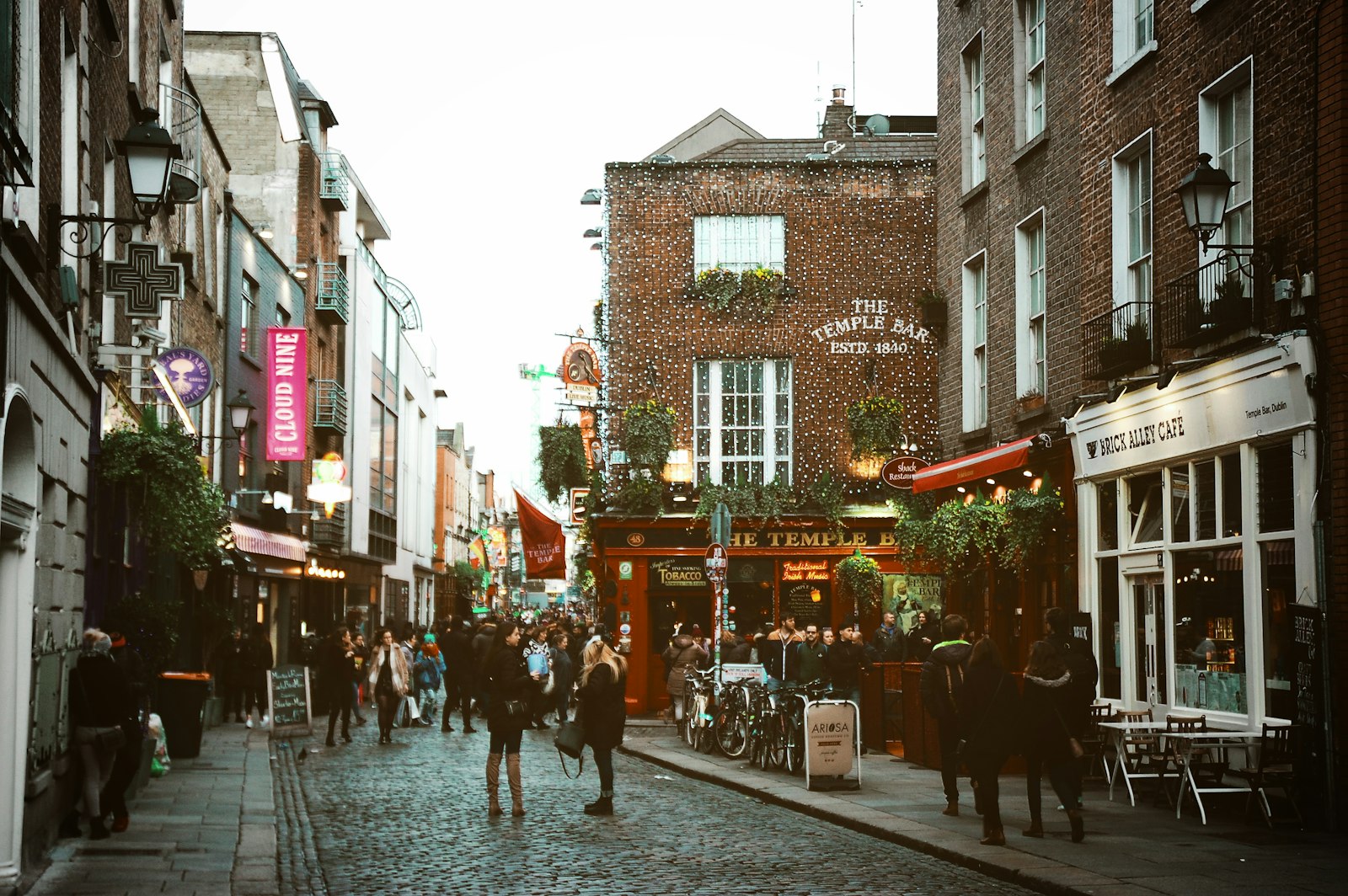
Georgian Dublin
Dermot Desmond · The Contrarian's Edge

Be right when the crowd is wrong.

How a Cork bank clerk with no degree built Ireland's leading brokerage, conceived the financial centre that reshaped Dublin, and turned a derelict airport into a 32-fold fortune: by backing the view almost nobody else would.

€2bn+Fortune built
32×City Airport, 1995–2006
30+ yrsHis longest holds
Scroll
The Premise

The crowd feels safe. The crowd is usually wrong.

Desmond has no formula and no degree. What he has is an information edge, a taste for the minority view, and the nerve to act on it: buy the asset everyone fears, back the people the market overlooks, keep enough cash that you are never the forced seller, then hold for years. He even built the board he wanted to play on. Do that with patience and wealth stops being a gamble. It becomes conviction, compounded.

The Seven Principles

The Doctrine

Each principle is drawn from what Desmond actually did and said, then paired with a way to translate it into your own decisions.

01The Minority

Seek the minority view.

This is his clearest stated principle. The crowd cannot, by definition, earn an above-average return, so consensus is a reason for caution, not comfort. The money is made where you are right and most people are wrong.

"We've all got to realise that the majority doesn't succeed; it's always the minority. So I am always looking for a minority view."

He pairs it with the flip side: "If you were to go by what the majority say, you'd never do anything." Consensus is the enemy of action.

Replicate

Before any decision, write down the consensus in one line, then ask what would have to be true for the opposite to pay. Only commit where you can defend the minority view better than the crowd can defend theirs.

02Judgement

Have no rules. Have judgement.

He calls himself an "eclectic investor" and refuses to be governed by formulas or price targets. The decision to buy, hold or sell flows from one question: what is right for the business and right for him as an owner.

"I don't have any rules about holding on to something or selling."

This is not recklessness. It is the confidence to judge each situation on its merits rather than hide behind a system that was built for a different one.

Replicate

Rules are training wheels; keep them until your judgement is better than they are. Then decide case by case on the underlying business, not on a number you set when you knew less.

03Fear

Buy what others fear. Then hold for years.

In 1995, with Docklands in recession and neighbouring Canary Wharf in receivership, Desmond bought London City Airport for about £23.5m. Eleven years later he sold it for a reported £750m, roughly thirty-two times his money.

The pattern repeats across Celtic, Betdaq, Daon and more: buy quality when the market is pessimistic and cheap, then hold while the value compounds. Maximum pessimism is the entry price; years is the holding period.

Replicate

Keep a list of quality assets you would own at the right price, and wait for fear to put them on sale. Then do the hardest thing: nothing, for years.

04Cash

Nobody can take cash away from you.

Cash, to Desmond, is the irreducible store of value and the floor beneath a share price. A strong balance sheet is what lets you act when others are forced to sell, and ensures you are never forced to sell yourself.

"Nobody can ever take cash away from you."

At Celtic he is associated with the same discipline: keep real reserves, so the club keeps its independence and never has to panic.

Replicate

Hold more cash than feels efficient. Its job is not return; its job is to make you the buyer in every crisis and the forced seller in none.

05People

Back the people and the structure, not just the asset.

When Desmond took a third of Latvia's Rietumu Banka, the reported reason was that he was impressed by its management team and its capital structure. He reads the people and the financial architecture before the asset.

A great asset with weak management or a broken balance sheet is a trap. A capable team with a sound structure can turn an ordinary asset into a compounding one.

Replicate

Underwrite the operator and the balance sheet first. If you would not back the people to run your own money, the headline asset does not matter.

06The Board

If you can, build the board you play on.

Desmond did not just find an edge; he created one. In 1986 he wrote the proposal for a low-tax financial centre and sold it to Charles Haughey. Legislated in 1987, the IFSC reshaped Dublin and anchored his own firms. He calls it the best thing he has been involved in.

He thinks the same way about the future: "I think you need to look at what's going to happen in the future and then plan backwards." The deepest edge is shaping the environment, not just reacting to it.

Replicate

Look for places where you can change the rules, not only play them: a standard, a market, a structure. Then plan backwards from where the world is going, not forwards from where it is.

07Freedom

Guard your independence.

Desmond is famously private, and deliberately so. He treats discretion as an operating advantage and autonomy as the actual point of wealth.

"The reason I left is to have the freedom to do what I want to do."

In the same breath: he is "avoiding politicians, avoiding the press and avoiding small-minded people." Freedom of action, not applause, is the prize.

Replicate

Decide what wealth is for early, and for most people the honest answer is autonomy. Protect it: stay discreet, keep your options open, and never let the crowd set your agenda.

The majority doesn't succeed.
It's always the minority.
An information edge, the nerve to act on it, and the patience to hold
Operate the Doctrine

The Instruments

Four tools attuned to Desmond's method: find the contrarian moment, let a holding compound for decades, demand a margin of safety, and check your conviction. Adjust the inputs; watch the lesson appear.

Contrarian

The Contrarian Gauge

Desmond got rich being right when the crowd was wrong. The best moments pair fear in the market with a real discount to what a thing is worth.

·
·

Patience

The Long Hold

Desmond is a holder, not a trader. Compounding does almost all of its work in the later years, which is why decades beat quarters.

·
·

Value

The Margin of Safety

Buy far enough below your estimate of worth that you are protected even when your estimate is wrong. The discount is the cushion.

·
·

Discipline

The Conviction Checklist

Run it before any meaningful commitment. Conviction is not a feeling; it is a set of questions you can answer yes to. All five, or you wait.

  • Can I state my edge in one sentence?
  • Are the odds genuinely in my favour (positive expected value)?
  • If this goes to zero, do I survive intact?
  • Am I acting on the minority view, not the crowd's?
  • Am I prepared to hold this for years?
Wait · 0 / 5

Tap each question you can honestly answer yes.

Trading screens showing market data
The markets  ·  NCB, and the patience to be right early
Proof of the Method

The Record

A clerk with no degree who built a brokerage, conjured a financial centre, and turned fear into a thirty-two-fold trade.

1950 born · 14 August

A Cork boy, raised in Marino

Born in Macroom, raised in Dublin, left school at eighteen with no degree. The self-made trajectory starts with no advantages.

1968 aged 18

A clerk at Citibank, Dublin

An apprenticeship in international banking, dealing rooms and foreign exchange. He learned the machinery before he owned any of it.

1981 aged 31

NCB, in the gap the establishment ignored

Founded as an interbank money-broker, a niche Davy and Goodbody did not hold, then built into Ireland's leading independent stockbroker.

1987 aged 36

The IFSC: building the board

He wrote the proposal for a low-tax financial centre and sold it to Charles Haughey. It reshaped Dublin and anchored his own firms.

1994 aged 44

Sold NCB; founded IIU

Crystallised the value in a trade sale to Ulster Bank, added the Quay software exit, and rolled the proceeds into his private vehicle, IIU.

1995 aged 45

London City Airport, bought in the slump

Acquired for about £23.5m with Docklands in recession; sold in 2006 for a reported £750m. Roughly 32 times his money. Celtic, too, dates from this year.

2025 aged 75

Barchester sold for £5.2bn

Backed in 1994 with McManus and Magnier and held thirty-one years. Patience, compounded.

Your Move

Find the view nobody shares.

Take one decision you are weighing. Write the consensus, then the minority case. If the minority case is stronger, you survive being wrong, and you can hold for years, size it with the Instruments above and act. If not, keep your cash and wait. The waiting is the work.